It’s not glamorous, and yes, people will make jokes. But portable sanitation is a steady, recession-resistant business with real demand. Somebody has to keep the job sites running, the festivals open, and the weekend races rolling — and that somebody could be you. Before you spend a dollar, it’s worth getting to know the industry you’re entering; the Portable Sanitation Association International (PSAI) is where operators go for training, standards, and best practices.
Here’s what most first-timers get backwards: they fuss over the toilets and treat the truck as an afterthought. Flip that. Your truck is the business. When it runs well, the whole day flows — routes stay on time, units stay clean, customers stay happy. When it doesn’t, the route falls apart by lunch. So before you buy a single unit, let’s talk about the truck.
Key takeaways
- Your truck is the business — buy for the routes you actually run, not the ones you’re hoping for.
- A slide-in tank (300–750 gallons) is the cheapest way to start; a dedicated service truck scales you into daily routes.
- Build it non-CDL so you can actually staff it through the driver shortage.
- A hybrid service/pickup & delivery truck that hauls and services in one trip can mean 30–50% more calls a day in busy season.
▶Watch: PSAI 2026 Wrap-Up — Flingin’ Poo in Daytona
What does the work actually look like?
Day to day, you’re dropping clean units where people need them, then running a route to service everything that’s already out there. At each stop, a vacuum pump pulls the waste into a holding tank, you rinse the unit down, and you top it off with a few gallons of fresh water and deodorizer before moving on. When the tank fills up, you empty it at an approved dump site and keep rolling. It’s honest, repeatable work — and it stops feeling complicated after about a week. Want the step-by-step? Here’s how these trucks actually work.
How much truck do you really need?
Start where your routes are, not where you hope they’ll be. Just getting your feet wet with a few events and a seasonal rush? A slide-in tank that drops into a pickup bed lets you start earning without betting the house. Growing into daily routes? A dedicated service truck with a bigger tank keeps you out of the dump line and on the road longer. Not sure where you land yet? Our rundown of equipment options lines every setup up side by side.
How many toilets can be serviced with one tank load:
| Truck | Usable waste | Toilets per tank load |
|---|---|---|
| Hino L6, 2,000 gal | ~1,200–1,275 gal | ~60–125 |
| Isuzu NRR, 895 gal | ~480–510 gal | ~25–50 |
| Ford F-550, 1,300 gal | ~720–765 gal | ~35–75 |
Which truck should you buy first?
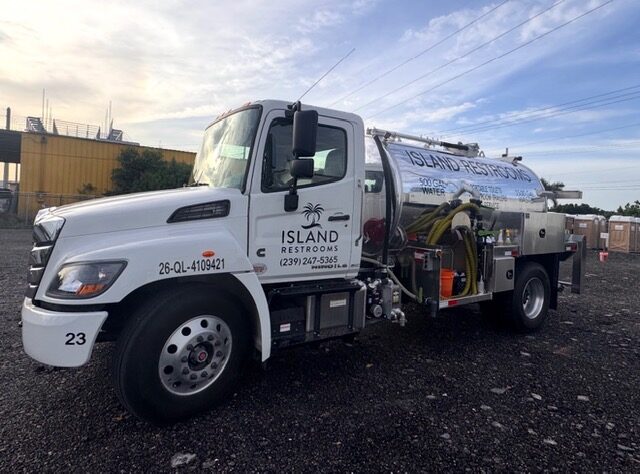
A handful of choices shape every single day on the route. A nimble cab-over like an Isuzu threads downtown blocks and tight job sites; a conventional chassis like a Ford gives you 4×4 and room to grow. Go with a flat tank and you can stack six to eight units right on the deck — now one truck delivers, services, and hauls away. A classic first setup, a 750-gallon waste tank with 350 gallons of fresh water, will carry you through roughly 100 toilets before you break for the dump. Our guide to choosing the right truck gets into the details.
And the big one: build it non-CDL. Good drivers are hard to find right now, and a truck anyone on your crew can legally drive is a truck you can actually keep moving. One operator we built for did exactly that — cut their dump trips nearly in half and freed up a seat for a helper. Here’s how that went.
How do you grow without drowning in overhead?
This is where a lot of operators get stuck. Growth usually means adding trucks, drivers, and overhead faster than the revenue catches up — and the sneaky profit-killer is running two trucks to do one job: one to drop units off, another to come back and service them. Double the fuel, double the driver, double the headache.
It doesn’t have to work that way. A truck that hauls and services in one trip folds both jobs into a single stop, and in peak season that can mean 30 to 50% more calls in a day — fewer miles, a leaner crew, and more left over at the end of the month. But that’s a hard call to see when you’re new to the business, which is exactly why it helps to have someone in your corner who’s built it all before.
Let’s figure out the right truck — together
Your first truck is a big decision, and you shouldn’t have to make it alone. We’ve spent years building portable sanitation trucks for operators who live on the route, so we know the questions to ask — about your routes, your crew, your busy season, and where you want to be in three years. Then we build around your answers, not around a spec sheet.
And when it’s time to grow — add a second truck, push into new territory, or build out a full fleet — that’s a conversation we have every day, too. We’ll help you scale up without buying more truck than you need.
So whether you’re speccing your very first unit or expanding a fleet you’ve already got rolling, take a look at our portable restroom & septic inventory or call the team. Let’s build something that fits the way you actually work.